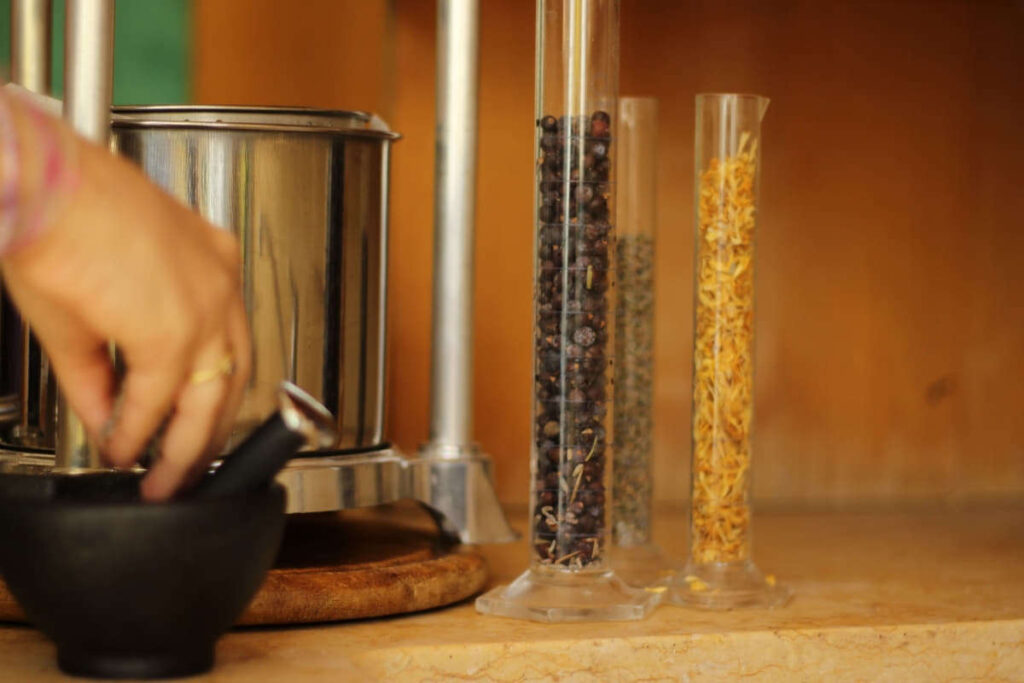
Most salve recipes use beeswax, but you can make a soothing, long-lasting herbal salve with only plant ingredients. This guide shows you how to make a vegan herbal salve in two stages: first an herb-infused oil, then the salve itself. You will also find ratios, herb ideas and storage tips.
What Is a Herbal Salve?
A salve (or ointment) is an herb-infused oil thickened with wax so it becomes a balm you can rub into the skin. Traditional salves use beeswax. Vegan salves use plant waxes instead, most often candelilla wax or carnauba wax. Both are firmer than beeswax, so you need less of them.
Ingredients and Equipment
- Dried herbs, such as calendula, lavender, plantain or chamomile
- A carrier oil: olive, sunflower, sweet almond or jojoba
- Candelilla wax (or carnauba wax)
- Optional: vitamin E oil to slow rancidity, and a few drops of essential oil
- A double boiler (or a heatproof bowl over a pot of water)
- A kitchen scale, cheesecloth, and small tins or glass jars
Step 1: Make an Herb-Infused Oil
Use dried herbs. Water in fresh plants can make oil spoil or grow mould.
Warm method (a few hours)
- Place the dried herb in a double boiler and cover it with oil, with about 2 to 3 cm (1 inch) of oil above the herb.
- Heat very gently, ideally below 50 °C (120 °F), for 2 to 4 hours. Do not let the oil smoke or fry the herbs.
- Strain through cheesecloth and squeeze out the oil.
Cold (solar) method (2 to 4 weeks)
- Fill a clean, dry jar about halfway with dried herb and cover it completely with oil.
- Close the jar and leave it in a warm place for 2 to 4 weeks, shaking it every few days.
- Strain well.
Step 2: Turn the Oil into a Vegan Salve
A good starting ratio is about 1 part candelilla wax to 8 parts infused oil by weight. For example, 12 g candelilla wax to 100 g oil. Use a little more wax for a firmer balm, or less for a softer one.
- Weigh the infused oil and wax and place them in the double boiler.
- Heat gently, stirring, until the wax melts completely. Candelilla melts at a higher temperature than beeswax, so be patient.
- Test the texture: dip a cold spoon in the mixture and let it set for a minute. Add more wax or oil if needed.
- Take the pot off the heat. Stir in a few drops of vitamin E and, if you like, essential oil. About 1% is plenty for most adults, so roughly 20 drops per 100 g.
- Pour into tins or jars, let it cool completely, then put on the lids and label them.
Herb Ideas for Your Salve
- Calendula: a classic for dry, irritated skin and minor scrapes
- Lavender: soothing and pleasantly scented, great for a first aid balm
- Plantain: traditionally used for insect bites and stings
- Chamomile: gentle and calming for sensitive skin
- Arnica (external use only): traditionally used for bruises and sore muscles. Do not use it on broken skin.
Storage and Shelf Life
Store salves in a cool, dark place. Most keep for about a year, depending on how fresh the oil was. If a salve smells sharp or rancid, throw it away.
Safety Tips
- Patch-test on a small area of skin first.
- Do not apply salves to deep wounds, burns that blister, or infected skin. See a doctor instead.
- Use essential oils at low dilutions, and avoid them on babies and young children unless a professional advises otherwise.
- Check that every herb is safe for you, especially during pregnancy.
Make Vegan Ointments With Us
In our herbalism course, you make lavender-infused oil and then three vegan ointments step by step on video: a lavender first aid ointment, a balm for muscle aches, and an ointment that supports the respiratory and immune systems. It is a great next step after this guide. You might also like how to make herbal tinctures and how to build a herbal first aid kit.
This article is for education only and is not medical advice.




Want to make your own natural remedies?
Learn to prepare tinctures, infused oils, vegan ointments and a natural first aid kit step by step in our herbalism course with herbalist Shir Gutman.